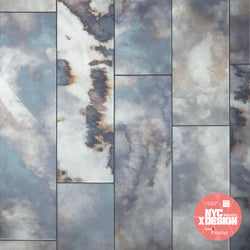
Billie navy mosaic
6-3/16" X 10-1/2" X 1/8"
Navy
Gloss
$98.00 per S/F
When it comes to porcelain vs glass tile, the beauty lies in how each works differently in a project. Porcelain tiles function both as a durable surface material for high traffic areas and as a refined option for bathroom walls, showers, and floors. Glass tile creates an unmistakable modern look, especially in backsplashes, pools, or anywhere you want to immediately brighten up the room with color and movement. This guide looks closely at both porcelain and glass tile, compares their unique benefits, and helps you make an informed decision for your next project.
The choice of material can make or break a space. That’s why porcelain vs glass tile comes up so often for homeowners, architects, and designers. Both are available in many styles and finishes, both are all beautiful choices, and both serve very different purposes.
Porcelain tiles: stand up to the toughest demands. They are impervious to water, stain resistant, and suitable for indoor and outdoor environments.
Glass tile: (and especially glass mosaic tile) provides translucent beauty, a high-contrast look that pairs well with stone, and is also a great choice for livening up walls, bathroom backsplashes, and showers.
If you want to create a look that feels modern, glass tile might be your best choice. Its translucent character and glossy surface brighten the design and pair seamlessly with bold grout colors for a more dramatic grid. You can use glass mosaics to create an unexpected focal point that draws the eye from across the room.
Porcelain tiles, on the other hand, create a more understated finished look. They come glazed, polished, or matte and are available in a wide range of materials and sizes. From large-format bathroom floors to wood-look tiles that make the space feel tailored and eclectic, porcelain tiles make it easy to achieve a wide variety of styles.
Porcelain is a great option if you’re putting tile in high traffic areas. It can be installed in kitchens, entryways, and bathrooms without worrying about scratches or stains. It’s non porous, so spills don’t sink in, and its weight means it can stand up to big projects.
Glass tile isn’t best suited for floors or heavy foot traffic. Instead, it shines on walls in showers, bathroom niches, and kitchen backsplashes. Since it’s non porous, it doesn’t harbor mold, which means it’s suitable for wet environments but not ideal for places where durable flooring is essential.
Porcelain installation can be heavier work, but once it’s in place, it functions as an easy-to-clean surface for decades. It doesn’t demand constant care and is often the easiest maintenance option for homeowners who want a long-term investment.
By contrast, glass tile needs a careful install. Glass mosaics look delicate and translucent, and it’s easy to see irregularities through them, which means grout color and spacing matter. This look works best when installed by a skilled artisan who understands how to balance the grout lines and accentuate the tile’s reflective movement.
If you prefer the clean look of a material that doesn’t require constant attention, porcelain is a great way to go. It’s the easiest maintenance tile material, especially for floors that see constant traffic or spaces prone to stains.
Glass tile doesn’t have pores, which is why it’s stain resistant and mold resistant. It’s also a carefree choice for showers, pools, or bathroom walls where you want the modern look of a bright, water-safe surface. However, scratches can show on glass more easily, so it’s best reserved for low traffic areas or walls.
Floors: bathrooms, hallways, kitchens, high traffic areas.
Walls: large slabs can be used on walls for a uniform design.
Showers: glazed porcelain makes a bathroom instantly feel upgraded.
Porcelain is often the most sensible option when you want something that stands up to both heat and moisture long term.
Walls: great for bathroom backsplashes or kitchen areas where you want color and shine.
Showers: glossy mosaics add a fun, playful dimension.
Pools: glass mosaics immediately brighten up outdoor water features with reflective beauty.
Accents: glass is best used to create an unexpected focal point that ties into the rest of the project’s design.
Glass tiles can easily become a unique statement in low traffic areas, especially when paired with colorful grout patterns or natural stone accents.
Porcelain tiles are available in shades like white, black, beige, cream, blue, or green, which offers a wide variety of possibilities when designing a space. They make it easy to go for the traditional or keep the more modern touch. You could even select a wood-look porcelain tile that provides a much needed warmth against glass.
Glass mosaics lean toward the bold side. If you want to go bold, glass is the perfect way to add a little pop of color and pattern. Its natural color variations and realistic textures create movement and depth in a way porcelain doesn’t replicate.
A creative approach: use porcelain as the main material and glass as an accent. This is a great way to add interest without overwhelming the rest of the room. For example, white porcelain bathroom walls look even more of a standout when paired with a glass mosaic trim that adds an edgy twist.
It’s easy to understand why designers often recommend mixing the two materials, they balance each other out while still letting plenty of texture and color into the room.
At the end of the day, porcelain vs glass tile comes down to the type of project you’re planning. If you want a low maintenance, stain resistant option that stands up to heavy foot traffic, porcelain is the strongest candidate. If you’re finishing a bathroom backsplash, shower, or pool where aesthetic appeal matters most, glass tile is often the better way to go. Both are all beautiful choices, and the one you select should feel like the right fit for your space.
Porcelain vs glass tile doesn’t have to be a difficult decision. If you want to create a timeless look, porcelain makes sense for floors and walls in high traffic areas. If you’d love to use glass mosaics for bathroom walls or pools, you can create a one-of-a-kind design that pulls together the rest of your room. At Artistic Tile, we’re here to help you find materials that inspire you and guide you through the installation process with confidence. We work with homeowners and designers every day to give projects the balance, texture, and beauty they deserve.
Read Less
6-3/16" X 10-1/2" X 1/8"
Navy
Gloss
$98.00 per S/F
6-3/16" X 21-1/16" X 1/8"
Ombre Blue
Gloss
$140.00 per S/F
6-3/16" X 10-1/2" X 1/8"
Light Blue
Gloss
$98.00 per S/F
6-3/16" X 10-1/2" X 1/8"
Dark Green
Gloss
$98.00 per S/F
6-3/16" X 10-1/2" X 1/8"
Grey
Gloss
$98.00 per S/F
6-3/16" X 10-1/2" X 1/8"
Ice White
Gloss
$98.00 per S/F
6-3/16" X 21-1/16" X 1/8"
Ombre Green
Gloss
$138.00 per S/F
6-3/16" X 10-1/2" X 1/8"
Pale Green
Gloss
$98.00 per S/F
6-3/16" X 10-1/2" X 1/8"
Moonbeam
Gloss
$98.00 per S/F
6-3/16" X 21-1/16" X 1/8"
Ombre Moonbeam
Mixed Finish
$140.00 per S/F
Fringe Thin
Anthracite
5" X 5" X 1/2"
$54.00 per S/F
Fringe Thin
Grey
5" X 5" X 1/2"
$56.00 per S/F
Fringe Thin
Rose
5" X 5" X 1/2"
$54.00 per S/F
Fringe Thin
Red
5" X 5" X 1/2"
$54.00 per S/F
Fringe Bold
White
5" X 5" X 1/2"
$54.00 per S/F
Fringe Bold
Anthracite
5" X 5" X 1/2"
$54.00 per S/F
Fringe Bold
Grey
5" X 5" X 1/2"
$54.00 per S/F
Fringe Bold
Rose
5" X 5" X 1/2"
$54.00 per S/F
Fringe Bold
Red
5" X 5" X 1/2"
$54.00 per S/F
Satin Glass
$165.00 per S/F
8" X 48" X 3/8"
Blue
Matte
$16.00 per S/F
24" X 48" X 3/8"
Blue
Matte
$17.00 per S/F
24" X 48" X 3/8"
Blue
Polished
$19.00 per S/F
24" X 48" X 3/8"
White
Matte
$16.00 per S/F
24" X 48" X 3/8"
White
Polished
$18.00 per S/F
8" X 48" X 3/8"
Grey
Matte
$15.00 per S/F
8" X 48" X 3/8"
White
Matte
$15.00 per S/F
24" X 24" X 3/8"
Ivory
Matte
$14.00 per S/F
24" X 24" X 3/8"
Ash
Matte
$14.00 per S/F
24" X 24" X 3/8"
Coal
Matte
$14.00 per S/F
$779.65 each
4-5/16" X 21-1/4" X 3/8"
Avorio
Matte
$18.00 per S/F
4-5/16" X 21-1/4" X 3/8"
Ecru
Matte
$17.00 per S/F
4-5/16" X 21-1/4" X 3/8"
Miele
Matte
$17.00 per S/F
4-5/16" X 21-1/4" X 3/8"
Tobacco
Matte
$16.00 per S/F
Antiqued Glass
$130.00 per S/F
23-5/8" X 23-5/8" X 3/8"
Grey
Matte
$15.00 per S/F
23-5/8" X 23-5/8" X 3/8"
Linen
Matte
$15.00 per S/F
23-5/8" X 23-5/8" X 3/8"
White
Matte
$15.00 per S/F
$536.20 each
24" X 48" X 3/8"
Brick
Raked
$17.00 per S/F
24" X 48" X 3/8"
Sand
Matte
$17.00 per S/F
24" X 48" X 3/8"
Sand
Raked
$17.00 per S/F
24" X 48" X 3/8"
Sand
Textured
$15.00 per S/F
24" X 48" X 3/8"
Smoke
Textured
$15.00 per S/F
24" X 48" X 3/8"
Charcoal
Textured
$15.00 per S/F
16" X 16" X 1/8"
Blue
Gloss
$60.00 per S/F
16" X 16" X 1/8"
Green
Gloss
$60.00 per S/F