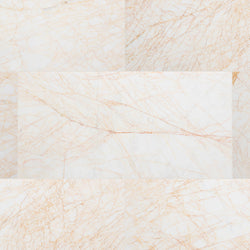
Zellige cloud white tile
4" X 4" X 1/2"
Cloud White
Gloss
$33.00 per S/F
Dolomite and ceramic tile each have unique strengths. Dolomite is natural stone with character and movement, while ceramic tile is crafted for consistency. Knowing how they compare will guide you toward the best choice for your kitchen, bathroom, or living space.
If you’re planning new tiles for a project, dolomite and ceramic tile often come up. One is a natural stone formed from calcium magnesium carbonate, the other is shaped from clay through a controlled production process. Both are available in a wide range of materials and sizes, but they perform differently once installed. Think about how each will handle acidic substances, how they react to spills, and the way they can shape the look of your spaces.
Dolomite has long been admired for its aesthetic appeal. It sits in the same family as limestone and marble, with calcite and carbonate minerals shaping its soft white and gray tones. Natural color variations and realistic textures are part of what make it unique.
This stone works well in kitchen countertops, bathrooms, and field tile layouts. When cut into slabs, dolomite can create movement and depth in the room. To really give your kitchen an architectural edge, dolomite can extend above the counters as a backsplash that pulls together the rest of the design.
Tile is a great option when you need predictable performance. Ceramic comes from clay and minerals, fired at high temperatures to harden the material. That process creates tiles that extend throughout the home in consistent colors and textures.
Ceramic tile is available in many styles and finishes, from glossy walls that immediately brighten up a bathroom to matte floors that are a carefree choice for family spaces. You can easily get creative with patterns, Create interest by combining different sizes or colors, and set the stage for a look that can grow with the space over time.
Dolomite has natural strength, but it doesn’t love acidic liquids. Everyday items like lemon juice or vinegar can cause etching. That’s why regular sealing is often suggested to help prevent staining. Still, dolomite can easily become a centerpiece in a kitchen when balanced with tiles that extend throughout the room.
Ceramic tile doesn’t react in the same way. Because it’s fired to hardness, it won’t show the same sensitivity to acidic substances. It also performs well with water absorption, so you can trust it in bathrooms and shower walls. This means they are an easy path to consistent performance without extra sealing.
Dolomite is softer than granite or quartzite, which means it can show scratches or staining under heavy use. Still, its surface finish has a natural quality that many people value. It’s easy to understand why designers often pair dolomite with mosaics for a little pop of color and pattern.
Ceramic is softer in terms of mineral strength, yet its predictability makes it practical for tiles across large spaces. Keep in mind that depending on the glaze and finish, ceramic tiles can look good in both classic and modern take that can define an entire room.
With dolomite, you get all beautiful choices tied to the earth. Its edges can be polished to a shine, or left matte for that understated finish. It’s a perfect example of how natural stone can add some cohesiveness to a kitchen or bathroom layout. By using a neutral-colored dolomite slab, you create a canvas that works with wood, quartz, or even granite accents.
Ceramic is different; it’s about control and versatility. If you want to go bold, you can choose patterned ceramic tile ideas to spark your new project. Keeping the more modern touch, ceramic tile can establish clean lines that beautifully contrast the natural look of wood cabinets or stone counters.
So which is the best choice? If you want to create a design anchored in natural stone, dolomite is the clear winner. It carries centuries of use in architecture, admired for its beauty, hardness, and timeless mineral makeup.
Ceramic is the alternative if you’re looking for consistency, a much needed low-care solution, and a material that can grow with the space over time. It can stand up to everyday life in kitchens and bathrooms without the extra steps of sealing.
Keep in mind that both are all beautiful choices, but the decision depends on how you plan to use them and what kind of look you want.
When you compare dolomite and ceramic tile, you see two different paths to design success. Dolomite is about natural minerals shaped by the earth; ceramic is about clay shaped by fire. Both can make a big impact on the overall feel of the room.
At Artistic Tile, you can find dolomite slabs, natural stone tiles, and ceramic collections that give you an opportunity to have a space that feels personal and complete. If you'd love to use dolomite for its natural color variations and realistic textures, or ceramic for its predictable finish, we have all beautiful choices that are also suited to kitchens, bathrooms, and beyond.
Read Less4" X 4" X 1/2"
Cloud White
Gloss
$33.00 per S/F
4" X 4" X 1/2"
Sea Spray
Gloss
$34.00 per S/F
4" X 4" X 1/2"
Sky Blue
Gloss
$33.00 per S/F
4" X 4" X 1/2"
Sand
Gloss
$33.00 per S/F
4" X 4" X 1/2"
Rose
Gloss
$34.00 per S/F
4" X 4" X 1/2"
Mediterranean Blue
Gloss
$31.00 per S/F
4" X 4" X 1/2"
Coriander
Gloss
$31.00 per S/F
4" X 4" X 1/2"
Cumin
Gloss
$31.00 per S/F
4" X 4" X 1/2"
Turmeric
Gloss
$33.00 per S/F
4" X 4" X 1/2"
Sumac
Gloss
$34.00 per S/F
2" X 6" X 1/2"
Cloud White
Gloss
$28.00 per S/F
2" X 6" X 1/2"
Sand
Gloss
$28.00 per S/F
Broken Joint 1.0cm
Bianco Dolomiti
Honed
$50.00 per S/F
Broken Joint 3.0cm
Bianco Dolomiti
Polished
$40.00 per S/F
Hexagon 3.0cm
Bianco Dolomiti
Polished
$45.00 per S/F
Straight Joint 1.5cm
Bianco Dolomiti
Polished
$40.00 per S/F
1x3" Chevron
Bianco Dolomiti
Polished
$47.00 per S/F
2-15/16" X 11-13/16" X 3/8"
Azul
Gloss
$12.50 per S/F
2-15/16" X 11-13/16" X 3/8"
White
Gloss
$12.50 per S/F
12" X 24" X 3/8"
Bianco Dolomiti Standard
Honed
$42.00 per S/F
12" X 24" X 3/8"
Bianco Dolomiti Standard
Polished
$41.00 per S/F
12" X 24" X 3/8"
Bianco Dolomiti Extra
Polished
$56.00 per S/F
12" X 24" X 3/8"
Bianco Dolomiti Select
Honed
$50.00 per S/F
24" X 24" X 3/8"
Bianco Dolomiti Select
Honed
$89.00 per S/F
4" X 12" X 3/8"
Bianco Dolomiti A1 Select
Honed
$36.00 per S/F
4" X 4" X 3/8"
Bianco Dolomiti
Honed
$48.00 per S/F
12" X 24" X 3/8"
Bianco Dolomiti Select
Polished
$50.00 per S/F
18" X 36" X 3/8"
Bianco Dolomiti Select
Polished
$91.00 per S/F
4" X 12" X 3/8"
Bianco Dolomiti A1 Select
Polished
$36.00 per S/F
A Mano Pyramide
Blue
8" X 8" X 1/2"
$62.00 per S/F
A Mano Pyramide
Green
8" X 8" X 1/2"
$65.00 per S/F
A Mano Pyramide
Natural
8" X 8" X 1/2"
$65.00 per S/F
A Mano Triangolo
Blue
8" X 8" X 1/2"
$65.00 per S/F
A Mano Triangolo
Green
8" X 8" X 1/2"
$65.00 per S/F
A Mano Triangolo
Natural
8" X 8" X 1/2"
$65.00 per S/F
Honed 12" x 24" x 3/8" Stone
$57.00 per S/F
Polished Stone
$50.00 per S/F
$506.25 each
$40.00 each