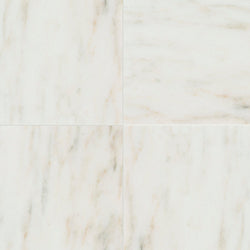
Calacatta gold marble tile
12" X 24" X 3/8"
Calacatta Gold
Honed
$71.00 per S/F
Danby marble from Vermont and Calacatta marble from Italy are two of the most admired white marbles in design. Danby offers soft gray veining and refined consistency, while Calacatta delivers bold movement and luxurious depth. Both bring timeless beauty to kitchens, bathrooms, and beyond.
When people picture white marble, two names often come to mind: Danby marble from Vermont and Calacatta marble from Italy. Both are natural stone selections that you can see in kitchens, bathrooms, and luxury projects around the world. But they are not the same. Each has distinct characteristics, each creates its own impact, and the one you choose will shape how the space feels.
This guide dives into what makes Vermont Danby marble and Calacatta marble different, so you can think about which stone fits your home best.
Danby marble is quarried in Vermont, deep in the mountains where the marble has been pulled for over a century. Types like Imperial Danby carry a reputation for consistency and reliability.
Calacatta marble, meanwhile, is quarried in Italy, in the Carrara region famous for producing Italian marbles. While Carrara marble itself leans softer in tone, Calacatta is the bolder sibling, with wide gray veins that beautifully contrast against a crisp white background.
Both stones carry history, but the quarry origin plays a major role in why they look and act so differently.
Vermont Danby tends to show a cleaner background with more consistent soft gray movement. It’s a stone that works well if you want the counters or island to act as a calm base that ties into the rest of the kitchen design.
Calacatta marble often comes with bold, unpredictable veining. This creates movement and depth in the slab, giving the room a strong personality.
If you want to go bold, Calacatta makes a statement. If you prefer something that can grow with the space over time, Danby might be the safer path.
You can order either marble as a honed marble or polished marble.
A honed finish softens the reflection, letting the stone feel a bit more lived-in. A polished finish creates shine that draws the eye from across the room.
This means they are adaptable in different ways; honed works beautifully in bathroom vanities that should feel casual, while polished slabs on kitchen countertops immediately brighten up the space.
| Attribute | Danby Marble | Calacatta Marble |
|---|---|---|
| Origin | Quarried in Vermont, USA | Quarried in Carrara, Italy |
| Appearance | Softer gray veining on a clean white background; more consistent tone | Bold gray veins with stronger movement on a bright white background |
| Absorption Rate | Lower absorption; more forgiving for kitchen countertops | Slightly higher absorption; spills should be wiped quickly |
| Veining | Subtle and understated; creates balance in design | Thicker, dramatic veining; creates movement and depth in slabs |
| Finish Options | Available honed or polished; works well in classic kitchens and baths | Available honed or polished; adds a luxurious element to bold designs |
| Best Use | Kitchen countertops, islands, backsplashes, bathroom vanities | Statement islands, high-contrast kitchens, bathroom walls and vanities |
| Pairing with Cabinets | Pairs beautifully with white cabinets for a refined, cohesive look | Pairs well with dark cabinetry for a high-contrast, modern take |
| Notable Variety | Imperial Danby with soft gray veining | Calacatta Gold with warm gray and gold tones |
Marble is naturally porous, so liquids can seep in and cause a stain. Both stones can also etch when exposed to acids like lemon juice or wine. But they don’t behave identically:
Neither option is perfect, but if you want to create a kitchen that’s more forgiving, Danby often comes out ahead.
Among the different marble varieties from Vermont, Imperial Danby is often called the most refined. It pairs a pure background with balanced veining that isn’t overwhelming. It’s no wonder that designers keep turning to Imperial Danby for bathroom installations, islands, and even backsplashes that extend above the counters.
By using a neutral-colored stone like Imperial Danby, you can create a one-of-a-kind space that doesn’t have to fight for attention.
Within the Calacatta family, Calacatta Gold is a perfect example of how subtle warmth changes the design. Its mix of gray and gold veining creates movement and depth in the slab, while also adding a luxurious element to kitchen counters or bathroom vanities. Pair it with brass fixtures, and the stone beautifully contrasts the metal, pulling together the rest of the design.
White cabinets with Danby marble create a timeless look that can feel calm and fresh. Dark cabinetry with Calacatta marble creates a high-contrast look that pairs well with modern design.
On a kitchen island, Calacatta might be the bold move that serves as a centerpiece, while Danby gives you an opportunity to have a more understated anchor. For a backsplash, both are beautiful choices. Danby tiles can look good if you want continuity throughout the rest of your counters, while a full Calacatta slab is a great way to add interest without overwhelming the design.
In a bathroom, the choice of marble can make or break the feeling of the space.
Danby creates a look that is soft, understated, and timeless due to its consistency. Calacatta creates an unexpected focal point that ties into the rest of the room with energy and strength.
If you’d love to use marble in a master bath, either stone is best used for vanities, shower walls, or even slabs that extend above the tub.
The debate of Danby marble vs Calacatta doesn’t have a single winner. It comes down to what you want:
You could even think about mixing both in one home; a Danby marble kitchen countertop with a Calacatta backsplash can balance the impactful design while letting each stone do what it does best.
In the end, both Danby marble and Calacatta marble are all beautiful choices. Each has natural color variations and realistic textures that inspire different styles. If you want to create a home that feels elevated by stone, these marbles give you the chance to make a statement.
At Artistic Tile, you can see slabs of Imperial Danby, Calacatta Gold, and other types of marble in person. With expert guidance, you can find the stone that pulls together the rest of the design and fits your vision perfectly.
Read Less12" X 24" X 3/8"
Calacatta Gold
Honed
$71.00 per S/F
18" X 18" X 3/8"
Calacatta Gold
Honed
$83.00 per S/F
24" X 24" X 3/8"
Calacatta Gold
Honed
$120.00 per S/F
6" X 12" X 3/8"
Calacatta Gold
Honed
$54.00 per S/F
12" X 24" X 3/8"
Calacatta Gold
Polished
$71.00 per S/F
18" X 18" X 3/8"
Calacatta Gold
Polished
$83.00 per S/F
24" X 24" X 3/8"
Calacatta Gold
Polished
$120.00 per S/F
24" X 48" X 3/8"
Calacatta
Honed
$20.00 per S/F
24" X 48" X 3/8"
Calacatta
Polished
$22.00 per S/F
Honed 18" x 18" x 3/8" Stone Aris Edge
$58.00 per S/F
12" X 24" X 3/8"
Calacatta Borghini
Honed
$59.00 per S/F
12" X 24" X 3/8"
Calacatta Borghini
Polished
$59.00 per S/F
4" X 12" X 3/8"
Calacatta Borghini
Honed
$51.00 per S/F
4" X 12" X 3/8"
Calacatta Borghini
Polished
$51.00 per S/F
3/4"
Calacatta Macchia Vecchia
Polished
$240.00 per S/F
3/4"
Calacatta Macchia Vecchia
Honed
$210.00 per S/F
3/4"
Calacatta Viola
Polished
$230.00 per S/F
3/4"
Calacatta Viola
Honed
$240.00 per S/F
1-1/4"
Danby Imperial
Honed
$260.00 per S/F
3/4"
Danby Imperial
Honed
$185.00 per S/F