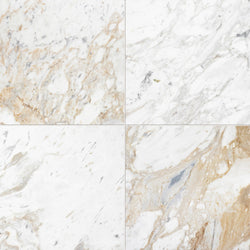
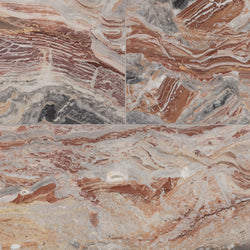
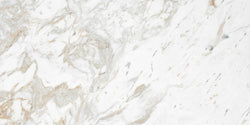
Calacatta gold marble tile
12" X 24" X 3/8"
Calacatta Gold
Honed
$71.00 per S/F
Arabescato marble vs Calacatta is a comparison of two of Italy’s most admired stones. Arabescato offers a very white background with jagged gray islands, while Calacatta is defined by bold gray and gold veining across a bright white surface. Both are highly sought marbles that inspire kitchens, bathrooms, and statement countertops in different ways.
Read More: Arabescato vs Calacatta – Find the Stone That Fits Your Space
If you’ve been comparing Arabescato marble vs Calacatta, you’re likely wondering which stone will give your space the right balance of elegance and impact. Both are quarried in the Carrara region of Italy, home to world-renowned Carrara marble as well. Yet their patterns, veining, and overall character are very different. If you want to create interiors that inspire, knowing what sets them apart will give you the clarity you need.
Both Arabescato and Calacatta are Italian marbles quarried in the Carrara area. This region has shaped architecture for centuries, producing stones admired for their timeless beauty. Carrara marble is often the everyday choice, while Arabescato and Calacatta are rarer, highly sought, and often reserved for luxury projects. The choice of material is less about status and more about the story you want your design to tell.
Arabescato marble is defined by a very white background accented with jagged white islands floating across shades of gray. These unique patterns are all about the symmetry and movement of the stone, creating interest without overpowering the room. The veining often shows milder markings and less pattern traffic compared to Calacatta.
Arabescato slabs are a carefree choice for kitchens, baths, and backsplashes. They are the perfect spot to use when you want understated elegance that can easily become a statement piece. If you’d love to use marble that adds cohesiveness to the room and immediately brightens up a countertop or vanity, Arabescato can give you that look.
Calacatta marble is often described as a bold move. It carries a white background with gray veining or gold veining that is thicker, more pronounced, and designed to draw the eye from one end of the slab to the other. This is a marble that inspires bold kitchens and statement islands.
Calacatta slabs are often used for kitchen countertops, backsplashes, and bathrooms where you want a design that creates movement and depth in the space. Some versions, like Calacatta Gold, offer warm tones that add a bit of edge to the space. This look works best when you want your interiors to stand up with confidence and inspire conversation.
| Attribute | Arabescato Marble | Calacatta Marble |
|---|---|---|
| Origin | Quarried in the Carrara area of Italy; rarer deposits | Quarried in the Carrara region of Italy; limited but more available than Arabescato |
| Background Color | Very white background with jagged gray islands | Bright white background that can carry warmer undertones |
| Veining | Softer gray veining with less pattern traffic and milder markings | Bolder gray or gold veining that draws the eye across the slab |
| Patterns | Jagged white islands create unique patterns and symmetry | Stronger, dramatic veining with natural color variations and realistic textures |
| Appearance | Understated elegance; refined look without overwhelming the space | Definitely a bold move; dramatic energy that adds a bit of edge |
| Common Uses | Kitchens, bathrooms, backsplashes, statement pieces | Kitchen islands, countertops, bathrooms, backsplashes |
| Finishes | Polished finish for shine, honed finish for a modern take | Available polished or honed; each creates movement and depth in the surface |
| Rarity | Highly sought, rare, and harder to source | Rare, but produced in slightly larger quantities than Arabescato |
| Design Approach | Best for understated elegance and balance in design | Best when you want bold, dramatic patterns that inspire conversation |
When you compare Arabescato marble vs Calacatta, you can find a material that fits the way you want your project to feel.
Background: Arabescato often has a very white background softened by floating gray islands. Calacatta tends to have a bright white background with bold gray and gold veining.
Veining: Arabescato’s veining is softer, showing less pattern traffic. Calacatta’s veining is stronger, creating natural color variations and realistic textures that can make a big impact on the overall feel of the space.
Patterns: Arabescato is best used for understated elegance. Calacatta creates movement and depth that beautifully contrasts the crisp white background.
Use: Arabescato slabs are a great way to achieve harmony in bathrooms and backsplashes. Calacatta is best for kitchen islands and countertops that are meant to inspire.
Rarity: Both are rare, but Arabescato is often harder to source. That rarity makes it even more desirable for high-end projects.
Both are all beautiful choices; the one you choose will work depending on your design vision.
Arabescato slabs can be installed in kitchen countertops where their patterns add timeless charm without overwhelming the space. This look works best when you prefer a clean design that can grow with the space over time.
Calacatta marble, on the other hand, is often the first pick for kitchen islands that serve as the centerpiece. The veining provides a modern take that can easily become the design anchor of the room. If you want to create a kitchen that inspires and immediately brightens up, Calacatta is also a great choice.
Bathrooms are the perfect spot to use either marble. Arabescato marble adds understated elegance to vanities and showers, giving you an opportunity to have a look that feels lived-in yet refined. Calacatta marble creates a bold contrast when used as a backsplash that extends above the vanity or bath wall. You could even combine the two, creating interest by pairing more refined Arabescato slabs with Calacatta’s bold veining.
Both stones are available as slabs and tile. Slabs are best for larger surfaces like kitchen islands, walls, or countertops where uninterrupted veining can inspire. Tile is a great option for smaller installations like backsplashes or bathrooms, where you can easily get creative with layouts.
Available in many styles and finishes, both stones come in polished finish for shine or honed finish for a modern touch. Each finish functions both as a stylistic decision and as a way to complement the rest of your interiors.
Both Arabescato and Calacatta carry natural imperfections, from small cracks to more natural variations. These are not flaws; they are the qualities that give each slab individuality. It’s easy to understand why designers value them — they certainly prove that it’s the individuality of stone that makes a project feel one-of-a-kind.
These stones are highly sought because they are rare, unique, and connected to centuries of Italian craftsmanship. If you prefer the clean look of Arabescato, you’ll appreciate its understated markings and sophisticated neutrality. If you want to go bold, Calacatta will give you the contrast and depth you’re after. Both can easily become statement pieces that pull together the rest of your space.
So, in the comparison of Arabescato marble vs Calacatta, which should you select?
Arabescato is for those who want soft veining, understated elegance, and a refined look that inspires without overwhelming.
Calacatta is for those who want bold patterns, movement, and countertops or islands that immediately brighten up the room.
Gone are the days of thinking one is better than the other. The real decision is about the story you want your space to tell. Both are quarried in Italy, both carry timeless beauty, and both are all beautiful choices that can stand up as lasting investments in luxury design.
Read Less12" X 24" X 3/8"
Calacatta Gold
Honed
$71.00 per S/F
18" X 18" X 3/8"
Calacatta Gold
Honed
$83.00 per S/F
24" X 24" X 3/8"
Calacatta Gold
Honed
$120.00 per S/F
6" X 12" X 3/8"
Calacatta Gold
Honed
$54.00 per S/F
12" X 24" X 3/8"
Calacatta Gold
Polished
$71.00 per S/F
18" X 18" X 3/8"
Calacatta Gold
Polished
$83.00 per S/F
24" X 24" X 3/8"
Calacatta Gold
Polished
$120.00 per S/F
Polished 18" x 18" x 3/8" Stone Aris Edge
$65.00 per S/F
24" X 48" X 3/8"
Calacatta
Honed
$20.00 per S/F
24" X 48" X 3/8"
Calacatta
Polished
$22.00 per S/F
Honed 24" x 24" x 3/8" Stone Aris Edge
$43.00 per S/F
12" X 24" X 3/8"
Calacatta Borghini
Honed
$59.00 per S/F
12" X 24" X 3/8"
Calacatta Borghini
Polished
$59.00 per S/F
4" X 12" X 3/8"
Calacatta Borghini
Honed
$51.00 per S/F
4" X 12" X 3/8"
Calacatta Borghini
Polished
$51.00 per S/F
High Honed 16" x 24" x 3/8" Stone Aris Edge
$49.00 per S/F
Honed Stone Hexagon 3.0cm
$46.00 per S/F
Honed Stone
$65.00 per S/F
3/4"
Calacatta Monet
Polished
$140.00 per S/F
3/4"
Calacatta Monet Extra
Polished
$160.00 per S/F
3/4"
Calacatta Monet
Honed
$140.00 per S/F
Polished Stone
$70.00 per S/F
1-1/4"
Arabescato Vagli
Polished
$265.00 per S/F
3/4"
Arabescato Vagli
Polished
$190.00 per S/F
3/4"
Arabescato Vagli
Honed
$175.00 per S/F
Honed 12" x 24" x 3/8" Stone Aris Edge
$42.00 per S/F
3/4"
Arabescato Corchia A1 Select
Polished
$205.00 per S/F
3/4"
Arabescato Corchia
Moonface
$120.00 per S/F
3/4"
Arabescato Corchia
Graffiti
$120.00 per S/F
3/4"
Arabescato Corchia
Honed
$205.00 per S/F
Honed 12" x 24" x 3/8" Stone Aris Edge
$32.00 per S/F